
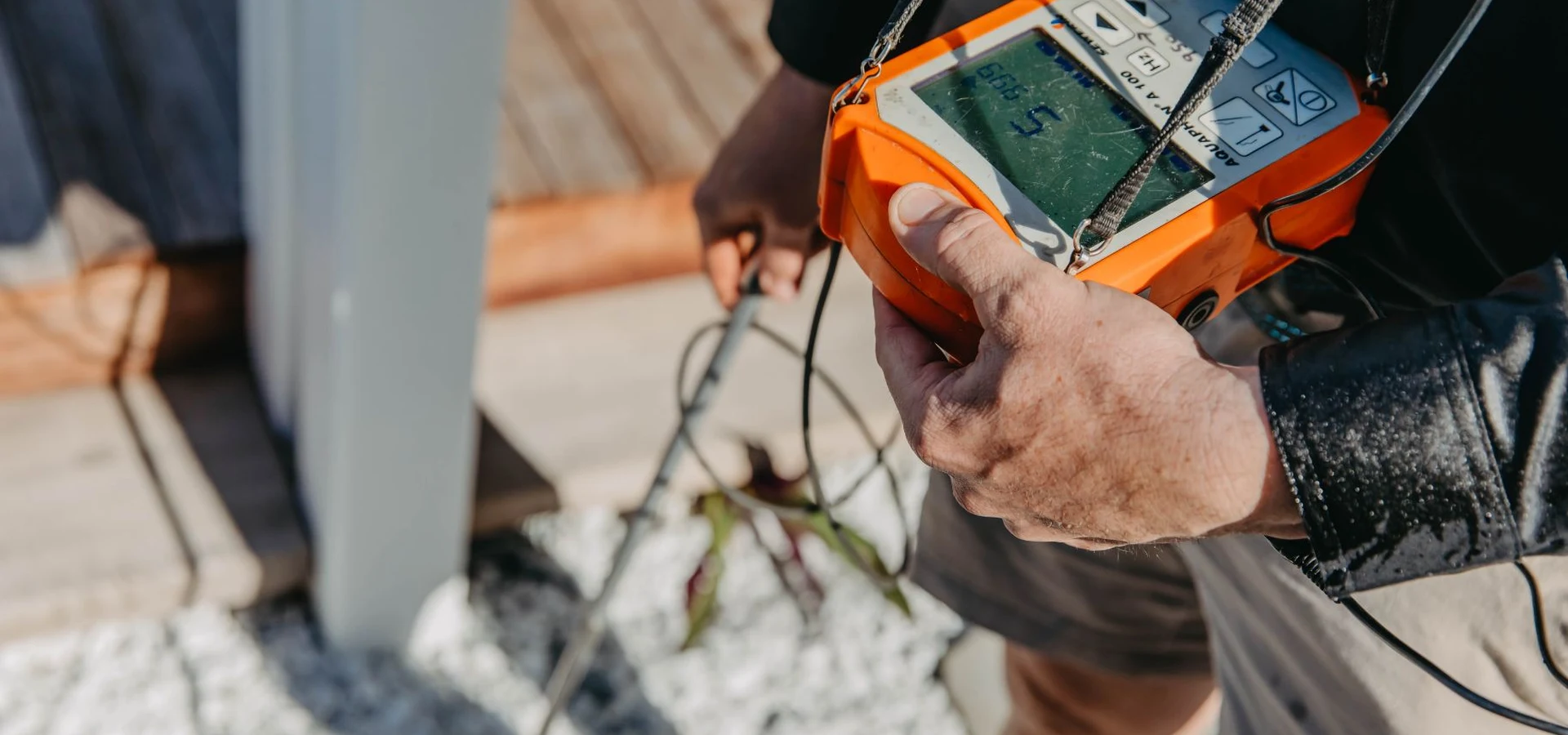
Water that has no business being there
If water is dripping through a ceiling, pooling on a floor or running audibly inside a wall, treat it as urgent. Our 24/7 line is open, and while you wait you can shut the main water valve, turn off power to any wet area at the breaker, and keep people out of rooms where water sits near outlets.
Leak detection is the work of locating a leak without guessing. A plumber starts with what you noticed, such as a stain, a hiss, a warm patch or a meter that keeps moving, then confirms the spot with instruments before any cutting begins. That order protects your drywall, tile and yard.
Meter still turning and every faucet closed?
A water meter that creeps forward while nothing is running, a bill that doubled, or a floor that feels oddly warm all point the same way. Water is leaving the system somewhere you cannot see.
The technical name for the fix is leak detection and pinpointing: separating supply lines from drain lines, then using sound, heat, pressure or gas to find the exact foot of pipe that has failed.
Run the two-hour meter test yourself
The US EPA describes a simple check that tells you whether a leak is likely before you call.
- 1
Stop all water use
Close every faucet, make sure no one flushes, and pause the dishwasher, washing machine and ice maker.
- 2
Read the meter
Open the meter lid and write down the dial or digital reading, including the small leak-indicator triangle if there is one.
- 3
Wait two hours
Keep every fixture off for the full two hours. Do not peek at the tap.
- 4
Read it again
Any change means a leak is likely. Tell us the difference, because it helps narrow the search.
Do not wait for the stain to spread
Call the 24/7 line and describe what you see, hear or read on the meter.
Signs a leak is hiding
People rarely see a leak first. They notice what it does.
A bill that jumped
The EPA says the average household leak wastes more than 9,300 gallons a year, and about nine percent of homes lose 50 gallons or more per day.
A brown ring on a ceiling
Water travels along joists before it drops, so the stain can sit several feet from the failed pipe.
A warm spot on the floor
A hot water line leaking under a slab heats the concrete above it. Bare feet find it before anything else does.
Pressure that sagged
Showers that weaken for no reason, or a faucet that sputters, can mean a supply line is losing water on the way.
How leaks get located
Different pipes and different hiding places call for different tools.
| Method | Best for | Limit |
|---|---|---|
| Acoustic listening | Pressurized lines in walls, floors and soil | Noisy traffic or loose fittings can mask the sound |
| Thermal imaging | Hot water lines, radiant heat, wet insulation | Cold lines show weaker temperature contrast |
| Tracer gas | Small leaks in buried or enclosed pipe | Needs the line isolated and drained first |
| Pressure test | Confirming a line is losing pressure | Says a leak exists, not where it is |
| Camera inspection | Drain lines and cleanouts | Shows drain pipes only |
Leaks in ceilings and walls
A ceiling stain usually sits below a bathroom, a kitchen or a roof penetration, but the stain is only where water finally gave up. Plumbers follow it back by mapping which fixtures were in use when it grew, checking supply and drain joints above, and scanning for heat or moisture before touching a saw.
Release trapped water from a bulging ceiling with a small hole over a bucket, and mark the stain's edge with a pencil so you can see whether it grows.
Under the house and in crawlspaces
Crawlspaces hide leaks because damp soil absorbs drips. Look for sagging insulation, musty air, rust on hangers or soft subfloor above, and check every joint, valve and drain with a flashlight.
Suspect a drain if the dampness spreads after you run a sink or tub, and suspect a supply line if it stays constant even with all fixtures off. Keep in mind that chronic moisture can also come from groundwater, which is a different job covered under basement waterproofing.
Buried service lines and underground leaks
Between the meter and the house, a pipe runs underground where you cannot watch it. A wet patch in the lawn that never dries, grass that stays greener in one stripe, or a meter that moves with the house shut off all suggest a failure in that run.
Acoustic equipment can pick up the sound of water escaping through the pipe wall, and tracer gas can confirm it. Once the spot is marked, you can decide whether to excavate or reroute, and the water line repair page walks through those options.
Slab leaks
Most plumbers use the term slab leak for a pressurized line failing beneath a concrete floor. This site does not have a separate slab page, so the essentials live here. Warm patches, a floor that feels damp, the sound of running water with nothing on, and a meter that never rests are the usual giveaways.
Choices after the locate include spot repair through the slab, rerouting the line through walls or attic space, or replacing the whole run. If the leaking line is old and the same material runs everywhere else, repiping is worth pricing out beside the patch.
Sprinklers, pools and the meter box
Irrigation lines leak at valves, risers and glued joints, and the water often seeps away unnoticed because it falls on lawn. A zone that stays soggy, a sprinkler head with weak spray or a meter that moves while the controller is idle points you to the culprit.
Last, look at the meter box itself. Water pooled around the lid can mean a failing fitting there, so tell the dispatcher before anyone digs.
When a hidden leak is an emergency
Some leaks can wait for the morning. These cannot, so call the 24/7 line the moment you see them.
Water near electricity
Wet outlets or a dripping light fixture are dangerous. Stay out and cut power at a dry breaker if it is safe.
A meter racing
If dials spin fast with fixtures off, close the main valve and note where it is, because it helps us on arrival.
Water where you cannot reach
A leak in a vacant unit, a locked basement or an occupied apartment above you needs same-day action, even after hours.
Water in empty space
A leak in a vacant unit or locked basement needs same-day action.
What Covington's housing means for hidden leaks
Covington had 20,576 housing units in 2020, and 12.0 percent of them were vacant. A pipe that fails in an empty house can run for weeks with no one to notice, so owners and managers of vacant property should read the meter on a schedule and know where the shutoff is.
Your drinking water comes through the Northern Kentucky Water District, so the meter in your yard belongs to that system. Ask NKWD where its side of the connection ends before assuming the leak is yours to fix.
What shapes the price of leak detection
Every house hides water differently, which is why the price starts with a conversation.
Frequently asked questions
Yes. Our 24/7 line takes leak calls at night, on weekends and on holidays. If water is actively coming through a ceiling or the meter is racing, call right away and shut the main valve while you wait.
Run the EPA two-hour meter test: read the meter, use no water for two hours, then read it again. Any change means a leak is likely. A jump in your bill or a warm floor spot are other clues.
It depends on how many methods are needed, where the pipe runs, the age of the pipe and how much access work follows. You get a clear price before work starts, and the dispatcher can explain what drives it when you call.
On this site slab leaks are handled within leak detection and then repaired through spot work, rerouting or replacement piping. The locate comes first, because it decides how much concrete has to be opened.
Ask the tenant to shut off the water to the unit if there is a valve, avoid the wet area, and call the 24/7 line. We can book same-day appointments when available, and you should photograph the damage for the insurer. Owners of rentals in Fort Wright and other nearby towns can call the same line.
The meter belongs to the water utility, which in most of Covington is the Northern Kentucky Water District. Ask NKWD where its responsibility ends, since a leak on its side is not yours to repair. If you are unsure which side the leak is on, call and we will help sort it out.