
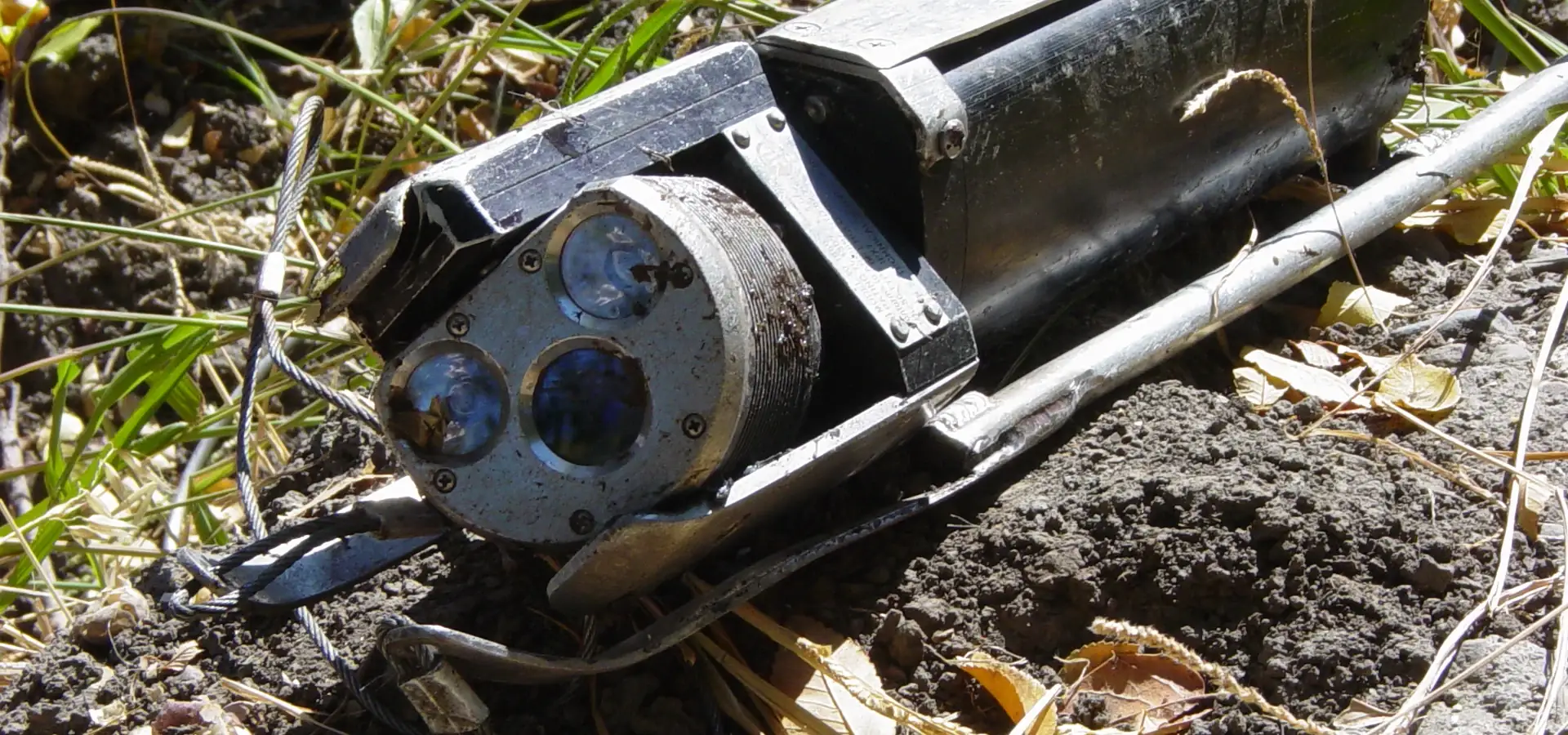
Why a plumber would put a camera in your sewer line
Sewer line inspection answers one question: what is the condition of the pipe between your house and the street? The line is buried, often under a yard, a driveway or a sidewalk, so nobody sees it until something goes wrong. A camera on a flexible rod, about the diameter of a coin, travels down the pipe and sends live video to a monitor.
For homeowners in Covington, KY the inspection is useful before buying, after a repeat clog, or before spending money on digging. It replaces a guess with a picture.
The drain keeps stopping up, the yard dipped, the basement smells
These are the symptoms that usually lead to a scope.
Same clog, third cable
If a cable clears it and the line slows again within weeks, something in the pipe is catching debris. The camera finds it.
Soft or sinking ground
A low spot above the line, or a sinkhole in the yard or street, can mean the pipe has failed and soil is washing in.
Smell of sewage outside
A strong odor near the house or cleanout may be a crack, a broken joint or a trap that has dried out.
Slow drains in a new-to-you home
Previous owners rarely mention a line that backs up in wet weather. The scope tells you before you learn the hard way.
How a sewer camera inspection works
The plumber enters the line through a cleanout or by pulling a toilet and pushes the camera down the pipe slowly. A distance counter shows how far the head has traveled, so a defect at 38 feet is marked at 38 feet. A transmitter in the camera head can be picked up with a handheld locator above ground, which lets the plumber mark the spot on the lawn.
That marking is called a locate. It matters when a repair is coming, because digging at the correct spot can save a lot of unneeded excavation. Ask for the footage and depth of any problem along with the video.
Want to see inside the pipe?
Call to book a camera inspection and tell us why you need one.
What a scope can and cannot tell you
A camera is a good tool, with limits worth knowing.
| It can show | It cannot show |
|---|---|
| Roots, grease and scale on the pipe wall | Pipe behind a full blockage that must be cleared first |
| Cracks, offsets and broken joints | Leaks in the water supply pipes |
| A belly where water pools in the pipe | Whether a crack will fail next month |
| Pipe material, such as clay, cast iron or plastic | Exact depth unless a locator is used |
| Where a defect sits, to the foot | What sits in the public sewer beyond your connection |
Who owns the pipe, and what SD1 says
Sanitation District No. 1 (SD1) describes the private lateral as the pipe from the building plumbing to the connection with its sewer, and the property owner owns and maintains it. That means a crack found by the camera on your side of the connection is your repair. SD1 has also run a program for defective laterals under public roadways, tied to pavement failure, building backup or overflow, and you should confirm whether it is available by calling SD1 at 859-578-7450.
Covington also has a combined sewer, one pipe carrying wastewater and storm water, in its older areas. If the camera shows a clean, sound lateral but your basement still backs up during storms, the issue is not your pipe. Having the video in hand makes that call to SD1 much more useful.
Scoping before you buy an older house
Home inspectors look at what is visible, and a standard inspection does not include the sewer line. Covington reached its peak population of 65,252 in 1930, and many of its houses are old enough to carry original or early replacement lines. General guidance: homes built before about 1960 can still have clay or cast iron lateral pipes that deserve a look.
Ask for a video of the whole run from the house to the connection. If the camera shows roots or an offset, you can negotiate repairs, ask the seller to address them or plan the work. A scope before closing costs far less than a surprise afterward, and it can be done during the inspection window.
The same scope is available for buyers in Park Hills and the other towns around Covington, where houses of different ages carry different pipe.
Reading the video with your plumber
Four things to look for as the footage plays.
- 1
Pipe material
Clay looks tan and jointed every few feet. Cast iron looks dark and rough. Plastic looks smooth and light.
- 2
Joints
Roots enter at joints as white hairs. A joint that is offset or open is a repair candidate.
- 3
Water line
A pool of standing water in the pipe marks a belly. A short one may be tolerable and a long one often is not.
- 4
Cracks and breaks
A crack along the pipe or a missing section shows soil or daylight. This is when repair or relining comes into the discussion.
What affects the price of a camera inspection
You hear a clear price before work starts. These items shift it.
Frequently asked questions
If a cable clears the drain and the problem returns within weeks, or if more than one fixture is slow, a camera finds the cause. Otherwise you may pay for repeated drain cleaning without fixing anything.
It depends on access, line length, whether the line needs cleaning first and whether a locate is included. You get a clear price before work starts.
For an older home, yes. A standard inspection does not cover the buried line, and the owner is responsible for the private lateral after closing.
No. It only travels through drain and sewer pipes. For supply-side leaks, see leak detection.
It is a sensible time. An empty unit gives full access to cleanouts and fixtures, and the footage shows whether past complaints about slow drains came from the pipe.
Ask when you book. A copy of the footage, with notes on distance and the type of defect, is what buyers and landlords usually want.