
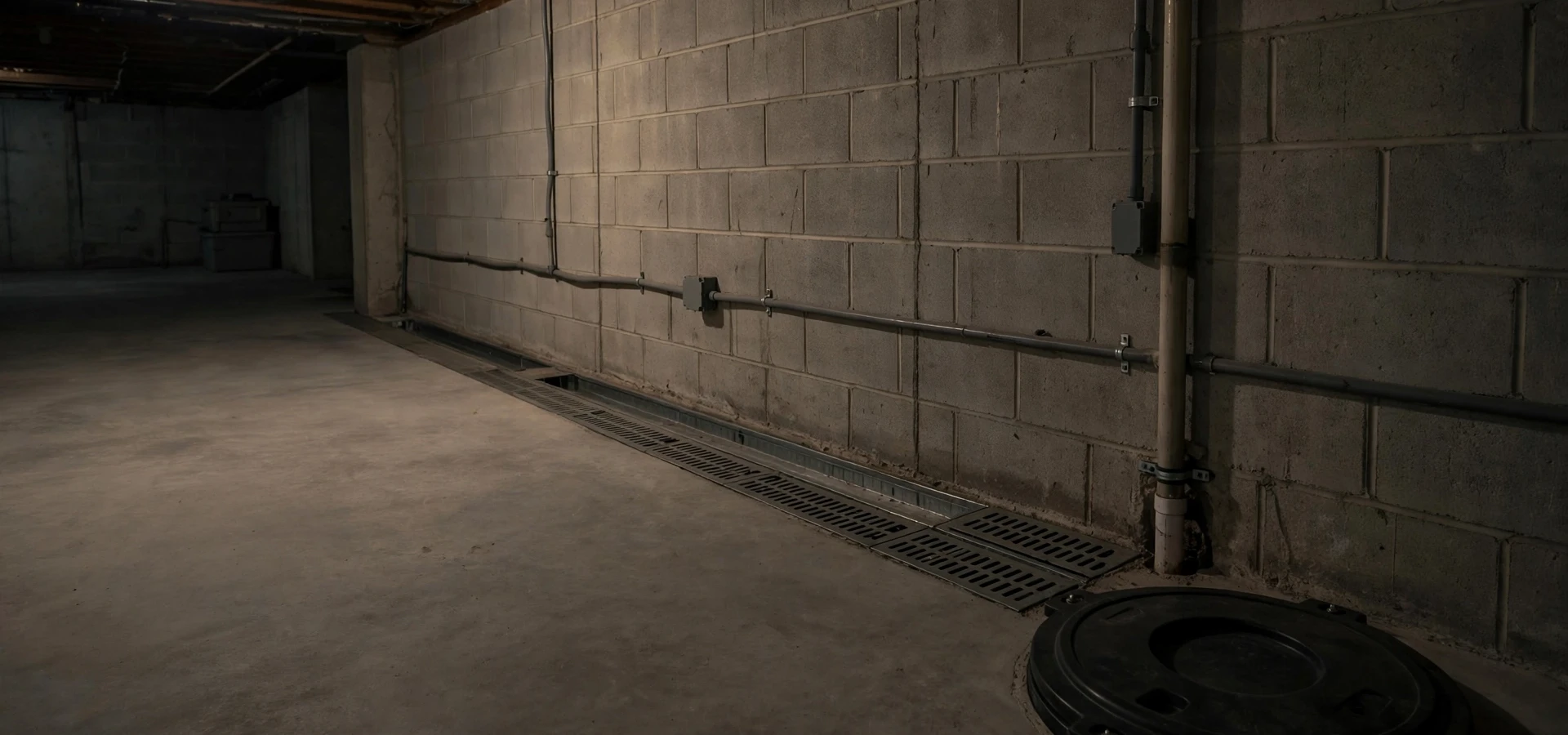
What interior waterproofing actually does
To waterproof a basement from the inside, you seal what you can on the walls, then give leftover water a path to leave. The usual system is a drain channel set along the footing under the floor edge, feeding a sump pit where a pump sends the water outside. Wall sealers and crack repairs help with small leaks. The drain and pump handle the pressure.
Think of it as water management, not a force field. Soil outside holds water and pushes it against the wall, a force called hydrostatic pressure. Inside systems, like our basement waterproofing installs, let that water in under control and move it out. They do not stop the water from existing.
Is it really groundwater? Check before you spend
Three different problems look like a wet basement. Each has a different fix.
Condensation
Cold concrete meets warm humid air and sweats. A dehumidifier and better airflow fix it, not a drain system.
Groundwater seepage
Water appears along the wall-floor joint or through cracks after rain. This is the case interior drainage is built for.
A plumbing leak
A supply or drain pipe leaks and wets the floor on dry days too. Waterproofing will not help, but a leak detection visit will find it.
Sewer backup
Dirty water rises from a floor drain or toilet. That is a sewer problem and needs a different response, covered below.
Surface water
Clogged gutters or a downspout that dumps beside the wall can mimic a seepage problem. Fix these first because they cost little.
A two-day moisture test you can run yourself
Do this before any contractor sells you a system.
- 1
Tape a plastic patch
Tape a 2-foot square of plastic sheet tight to the wall and floor, sealing every edge. Pick a spot that looks damp.
- 2
Wait 24 to 48 hours
Leave it alone. Do not run a dehumidifier in that room, or you will spoil the result.
- 3
Read the surface
Droplets on the room side of the plastic mean condensation. Moisture behind the plastic, on the wall, means water is passing through the concrete.
- 4
Repeat after rain
Try it again a day after a heavy rain. If the patch is dry in dry weather but wet after storms, you have groundwater seepage.
Interior methods compared
Short cell text, honest limits.
| Method | Best for | Limit |
|---|---|---|
| Hydraulic cement in cracks | Small active cracks | Can fail if the wall keeps moving |
| Masonry waterproofing coating | Light dampness, dusty walls | Peels under real water pressure |
| Interior perimeter drain with sump | Seepage along the wall-floor joint | Needs a working pump and power |
| Wall vapor panels over a drain | Finished basements, hidden leaks | Hides the wall from view |
| Dehumidifier | Condensation and musty smell | Does nothing for seepage |
| Downspout and grade fixes outside | Roof and surface water | Does not help with a high water table |
The drain and sump, step by step in your head
A crew breaks out a strip of floor about a foot wide along the wall. They set a perforated pipe or channel on the footing, cover it with washed stone, and patch the concrete over it. The channel slopes toward a sump pit, usually 18 to 24 inches wide and about 24 to 30 inches deep.
The pump in that pit does the final work. It needs a clear discharge line that carries water well away from the house, and a check valve so the water does not fall back. If your home already has a pit that is old or noisy, a sump pump repair visit may be cheaper than a full system.
A rule of thumb on the wall
Seal cracks only after you have a plan for the water behind them. Pack a crack tight and the water pushes sideways to the next weak spot, often a mortar joint or the floor edge. A drain gives that water somewhere to go.
What you can do this weekend
These steps are low-risk and often cut seepage by themselves.
- Clean gutters and extend each downspout at least 5 to 6 feet from the foundation.
- Regrade soil so the ground falls away from the wall, about 6 inches over the first 10 feet.
- Move stored boxes off the floor and away from the walls.
- Run a dehumidifier and keep the basement near 50 percent humidity.
- Test the sump pump by pouring a bucket of water into the pit and watching it switch on.
- Mark where water first appears and note how soon after rain, then keep that note for your plumber.
What interior systems cannot do
An inside drain cannot hold back a river. If surface water floods the lot and rises over the floor, the pump only moves as fast as its motor allows. Sewer backups are separate again, because a sump pump discharges outside and has no connection to the city sewer.
Interior systems also cannot repair a bowed or failing wall. If you see horizontal cracks, a wall leaning inward, or sliding mortar, call a structural pro. Keep the plumber for the water side.
Mistakes that waste money
Painting over wet walls
Paint holds only until pressure builds behind it. Then it blisters and peels within a season.
Skipping the discharge line
A pump that dumps beside the house just recirculates water into the same soil.
Burying the sump under a cover that is not sealed
Radon and humidity can rise through an open pit. Use a lid designed for it.
Forgetting power loss
Storms that bring water also knock out power. A battery backup keeps the pit working.
Hiring without a diagnosis
A contractor who quotes a system without asking where and when water appears is guessing.
Safety and when to call right away
Standing water near outlets, a panel, or a furnace is an electrical hazard. Do not step in it. Turn off power from a dry spot, or leave it and call, and keep children and pets out of the room.
A basement that fills fast, smells like sewage, or has water over the floor drain needs a call at any hour. Our 24/7 emergency line takes those, and a plumber can tell you on arrival whether the source is groundwater, a broken pipe, or a backup.
Covington, KY: what to know before you start
Covington sits where the Ohio and Licking Rivers meet, and the Ohio at Cincinnati crested at a record 80.0 feet on January 26, 1937, against a flood stage of 52 feet. Covington flooded then too. That history is a reminder that lowland lots can see high groundwater, so ask a plumber about a backup power source for any pump.
Older parts of Covington also use a combined sewer, which carries wastewater and stormwater in the same pipe. Sanitation District No. 1 notes that overflows can back up basements. A sump pump will not stop that. If your drains back up in heavy rain, call SD1 at 859-578-7450 and ask a plumber to check your private lateral.
Source type: NWS (1937 crest), W (Covington flooding), SD1 (combined sewer)
Frequently asked questions
Yes, interior drainage and sealing are standard for existing homes. They handle seepage by moving water out. Exterior excavation does more to keep water away from the wall but costs far more in digging.
Many jobs finish in a few days, depending on basement length and finishes. Concrete needs time to cure before heavy loads return. Ask the plumber for a schedule before work starts, whether you live in Covington or Park Hills.
Permit rules vary, so ask the Kentucky Division of Plumbing or the local plumbing inspector before work starts. Work covered by concrete must be inspected before it is covered.
It cuts the moisture that mold needs, but it does not remove mold already growing. Dry the space, fix the source, and clean or remove affected materials. Heavy growth needs a mold specialist.
The price depends on basement length, floor thickness, drain type, pump size, and how the water gets to the outside. You get a clear price before work starts. Call our 24/7 line to describe your basement.
That depends on your lease and the cause. Tell your landlord or property manager in writing, with dates and photos, and ask them to call a licensed plumber.
Not directly, but it shows how far the Ohio can rise, and the city flooded then. Lowland basements may sit close to a high water table. Ask a plumber about a battery-backed pump, and see our Ludlow service area page for river-edge guidance.