
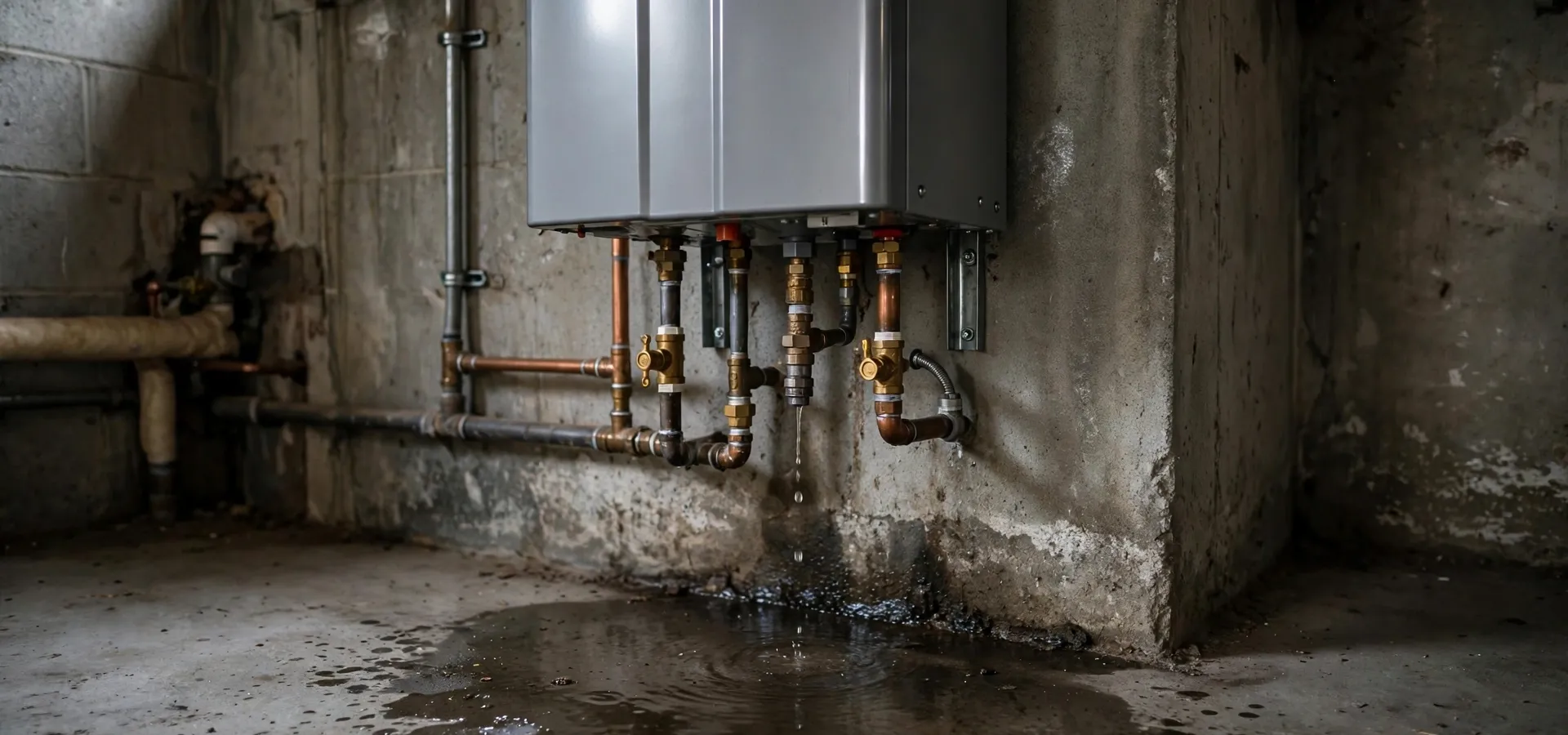
If it is leaking right now, do this first
Stop the water, then work out why. Use these four moves in order.
Close the cold supply
Turn the cold inlet valve under the unit a quarter turn to stop water entering. If you cannot reach it, close the main water valve for the house.
Cut the power
Unplug the unit or switch off its breaker, but only from dry footing. Do not touch the unit or any outlet while standing in water.
Close the gas valve
On a gas model, close the gas valve to the unit. If you smell gas at any point, leave the building and call your gas utility or 911 before anything else.
Catch and photograph
Put a pan or towels down, photograph the leak and the wet area, and note when it started. A plumber and an insurer will both ask.
The short answer: read the drip location
A tankless water heater leaks for four main reasons. Fittings loosen, internal seals wear out, condensation drains the wrong way, or the heat exchanger cracks. Each shows up in a different spot, so look before you guess.
Dry the floor, put a paper towel under each fitting, and check again in an hour. A drip at the bottom connections is the easy case. A leak from the case itself, or water running down from inside, points at a harder fix.
Where the water shows up, and what it means
Match your leak to the closest case.
Bottom connections
The water and gas fittings at the base can loosen from heat cycling. A worn washer or union is a short repair.
Isolation valve ports
Service valves have rubber O-rings that dry out over years. If you recently flushed the unit, an O-ring may not be seated.
Pressure relief valve outlet
A drip here can mean high water pressure or a failing valve. Either needs attention, and the valve should never be capped.
Condensate drain or trap
High-efficiency units make acidic condensate that drains through a small tube. A clogged tube sends it onto the floor.
Inside the case
Water running from the front panel or vent means an internal leak. A cracked heat exchanger is the worst answer and usually ends the unit's life.
Cause, severity, and next step
| Cause | How serious | Next step |
|---|---|---|
| Loose fitting at the base | Low | Plumber tightens or replaces the washer |
| Worn O-ring on isolation valve | Low | Replace the O-ring and reseat the valve |
| Clogged condensate drain | Medium | Clear the line and neutralizer, then test |
| High water pressure | Medium | Check pressure and add a regulator or expansion control |
| Failed relief valve | Medium | Replace the valve, never plug it |
| Cracked heat exchanger | High | Shut off and plan a replacement |
Condensation is not always a leak
Condensing tankless models pull so much heat from exhaust that water vapor turns to liquid inside the unit. That water is mildly acidic and runs to a drain through a small plastic line, sometimes through a neutralizer cartridge. If the line kinks or fills with debris, it spills.
Short bursts of dripping from the exhaust or a damp spot near the vent can be normal in cold weather. A steady stream is not normal. If you cannot tell, a plumber can check the slope of the vent and the condensate path.
How old is the unit?
The US Department of Energy puts a tankless water heater's life at about 20 years. A leak in a unit near that age often means the heat exchanger is giving out, and replacing it can make more sense than another repair. In a younger unit, the cause is usually a fitting or seal.
What you can check without tools
Do these only after the unit is shut off and dry.
- Look at the hot and cold pipes for wet spots, green crust, or rust at joints.
- Check the relief valve outlet for a drip trail on the pipe or wall below.
- Feel the floor under the unit for warmth, which may mean a hidden line.
- Look at the condensate tube for kinks, clogs, or a missing drain connection.
- Read the error code on the display and write it down.
- Check the water pressure with a gauge on an outdoor spigot, if you have one.
Mistakes that turn a drip into a bigger job
Over-tightening a fitting cracks it. Wrapping tape around a leaking joint hides the problem for a week. Capping a relief valve outlet is dangerous, since the valve exists to protect the unit from over-pressure.
The other mistake is waiting. A slow drip near the electrical board can short it, and a leaking gas unit may not vent correctly if water reaches the burner. A 10-minute call now is cheaper than a ruined control board.
Repair or replace: how a plumber decides
The plumber looks at age, leak source, parts availability, and the unit's service history. A fitting leak on a unit under ten years old is nearly always worth fixing. A cracked heat exchanger on a unit past fifteen rarely is.
If a replacement is the right call, ask about venting, gas line size, and whether the old isolation valves can stay. Our tankless water heater service covers new installs and our water heater repair crew handles diagnosis first, so you only replace when the facts say so.
Why minerals matter for leaks
Scale does more than waste energy. It can stress seals and valves, and sections of a heat exchanger that overheat under scale can crack. A yearly flush is cheap insurance.
There is no verified hardness figure to quote for local water. Test your own tap with a hardness strip and ask the water utility for its annual water quality report, then plan the flush interval from that.
Covington, KY: what to know before you start
Northern Kentucky Water District serves 99 percent of Kenton County households, drawing from the Licking River at the Taylor Mill plant and from the Ohio at Fort Thomas and Memorial Parkway. Mineral content affects how fast scale builds inside a tankless unit, so test your tap and ask the district for its annual water quality report.
If your leak turns out to be from an old unit, the Department of Energy puts the lifespan near 20 years. Homes in Fort Mitchell and Park Hills often have a mix of original and updated plumbing, so a plumber should check supply lines when swapping the heater.
Source type: KCPC (NKWD service and plants), DOE (tankless lifespan)
Frequently asked questions
It can be. Water near the electrical board raises shock and shorting risks, and a gas model may vent badly if water reaches the burner. Shut off water, power, and gas, and stay out of standing water.
Not for long. Small drips grow, and they can hide cracks. Shut the unit down and have a plumber check it.
Usually high water pressure or a worn valve seat. A plumber can test the pressure and replace the valve if needed. Never cap the outlet.
It depends on the leak source, parts, access, and the unit's age. You get a clear price before work starts. Call our 24/7 line to describe what you see.
Tell your landlord or property manager right away, in writing, with photos. They typically arrange the repair through a licensed plumber.
Yes. Our 24/7 emergency line takes these calls, and same-day appointments are available when the schedule allows.
It can contribute, since minerals build scale that stresses seals and exchangers. Northern Kentucky Water District supplies 99 percent of Kenton County households. Test your tap and ask the district for its annual report, since we have no verified hardness figure to quote.