
Why the pump quits when you need it most
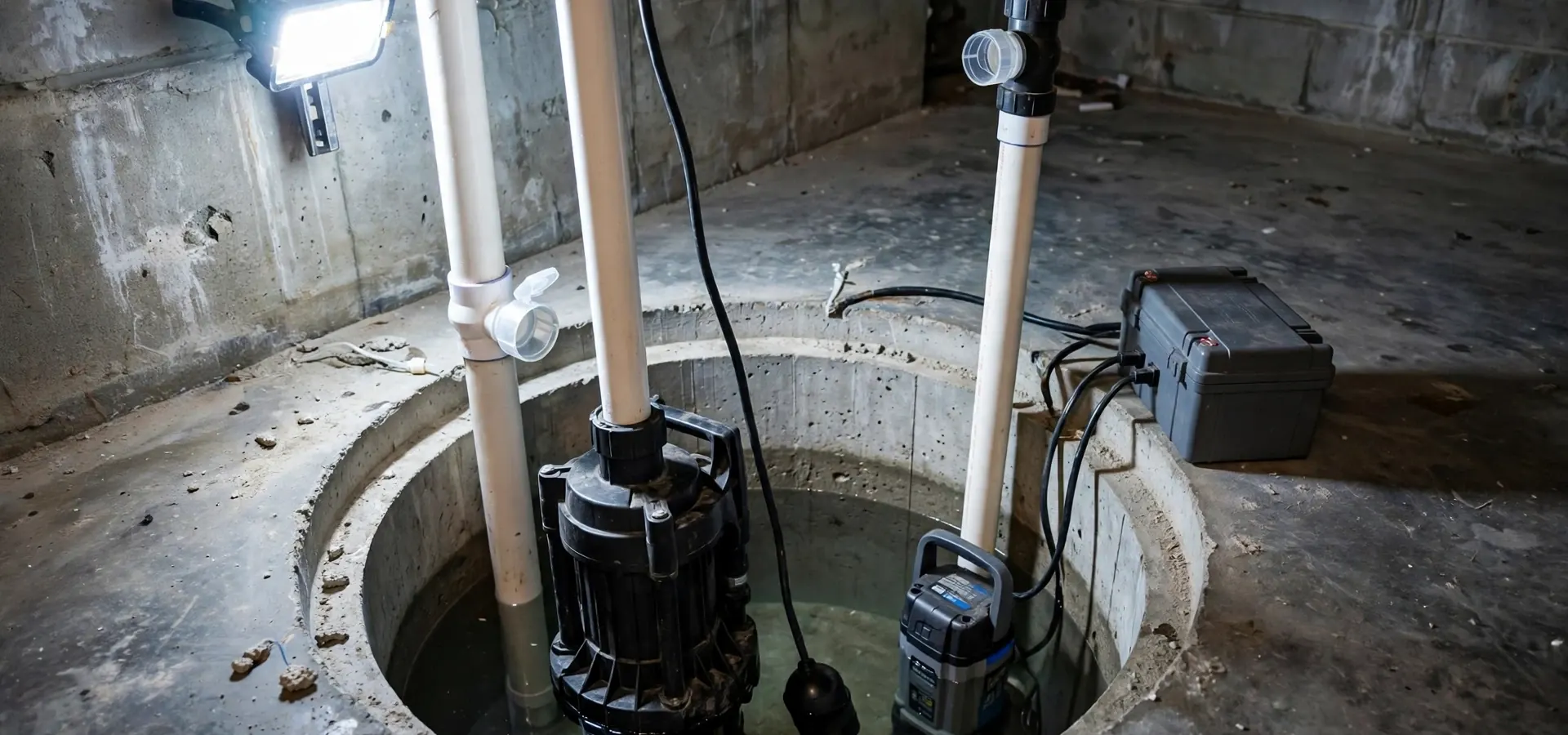
Heavy rain and power outages arrive together. A standard sump pump runs on household current, so a downed line or tripped breaker stops it just as the pit fills. A battery backup sump pump is a second pump, wired to a deep-cycle battery and its own float switch, that takes over when the main pump cannot run.
Power is not the only reason pumps stop. Stuck floats, clogged intakes, and worn motors fail on sunny days too. A backup also covers those cases, because it sits slightly higher in the pit and starts when water climbs past the main pump's reach.
Backup types and where each fits
Pick by how often you lose power and how much water arrives.
| Type | How it runs | Good for | Watch out for |
|---|---|---|---|
| Separate DC backup pump | Own battery, own float | Most homes with one pit | Battery needs replacing in time |
| Combination primary and backup unit | One system, two motors | New pit installs | Cannot service one half alone |
| Water-powered backup | Uses municipal water pressure | Homes with steady pressure and no battery room | Uses a lot of water, and check local rules |
| Generator-fed primary pump | Runs the main pump on generator | Homes already owning a generator | Needs manual start and fuel |
| Whole-house battery system | Powers pump with other loads | Large homes with solar and storage | Cost and complexity |
How a plumber installs a backup
The work is usually a few hours when the pit is in good shape.
- 1
Inspect the pit and discharge
The plumber checks pit size, the check valve, and the discharge line. A pit under about 18 inches across may not hold two pumps.
- 2
Set the backup higher
The backup pump sits on a base or bracket so its float triggers a few inches above the main pump's float. That way it only runs when the primary fails or is overwhelmed.
- 3
Run a separate discharge
Best practice is a second discharge pipe, with its own check valve, so the two pumps do not push against each other. Where one line is unavoidable, a proper tee fitting is used.
- 4
Wire, charge, and test
The controller connects to the battery and plugs into an outlet. The plumber tests the pump by filling the pit and then unplugging the main pump to prove the backup starts.
What to ask for in the quote
Details that separate a lasting setup from a weak one.
A deep-cycle battery
A car battery is built for short bursts. A marine or AGM deep-cycle battery tolerates the long drain a pump needs.
A high-water alarm
An audible alarm, or a phone alert on a smart controller, tells you the pit is rising before the floor floods.
A vented battery spot
Flooded lead-acid batteries release gas while charging. Keep them in a ventilated place, up off the floor.
A pump sized for the job
Capacity is measured in gallons per hour at a given lift. Ask the plumber how they sized it for your discharge height.
A tested check valve
A check valve stops pumped water from falling back into the pit. A worn one makes the pump cycle all day.
A runtime reality check
A fully charged deep-cycle battery can run a backup pump for several hours of continuous pumping, but far longer if water enters slowly and the pump cycles. A long outage in a downpour can still drain it. Ask the plumber for the expected runtime with your battery and pump, and plan for a way to recharge or swap.
Keep it ready: a simple maintenance routine
Ten minutes every few months beats an emergency call.
- Pour a bucket of water into the pit every three months and watch both pumps start.
- Unplug the main pump on purpose once a year and confirm the backup runs.
- Check the battery terminals for white crust and clean them with a baking soda paste.
- Look at the controller lights and read what they say about charge state.
- Replace the battery on the schedule in the manual, often every three to five years.
- Clear leaves and grit from the pit and the discharge outlet outside.
Mistakes that make backups fail
The biggest is never testing. Owners install a system, forget about it, and find a dead battery during the first storm. Another is wiring both pumps to the same float, so one stuck switch disables both.
Freezing is a second trap. A discharge line that ends in a buried or capped outlet can ice shut in a cold snap. Keep the outlet clear, and ask your plumber whether a frost-protected outlet fits your yard.
What a sump pump, even a backed-up one, will not do
A sump pump moves groundwater out of a pit. It has no link to the city sewer. If your floor drain or toilet backs up in a storm, the cause is in the sewer, and a bigger pump will not help.
Water coming through the wall in large amounts may also need a better drain around the footing. Our basement waterproofing service pairs a drain system with the pump. If the pit itself is old or noisy, a visit from our sump pump repair team can tell you whether to repair, replace, or add the backup.
Electrical safety around a flooding pit
Never reach into a pit while a pump is plugged in, and never stand in water to reset a breaker. If water is near outlets or the panel, stay out, shut off power only from a dry spot, and call. Keep the area clear of children and pets.
Battery systems carry power even when the house is dark. Treat the terminals as live, and keep tools and jewelry away from them.
Covington, KY: what to know before you start
Covington lies at the confluence of the Ohio and Licking Rivers. In the 1937 flood, nearby Ludlow lost running water and gas, and more than 43 percent of that city sat underwater. A pump cannot win against that, but it shows why a plan for power loss belongs in any low-lying basement.
Sanitation District No. 1 says older areas like Covington have a combined sewer that carries wastewater and stormwater together, and overflows can back up basements. A battery backup pump does not stop that kind of backup. If you see sewage rising in a drain, call SD1 at 859-578-7450 and a plumber, and read about our service in Ludlow or Taylor Mill near the Licking.
Source type: KLIB (Ludlow 1937), SD1 (combined sewer, phone), W (confluence)
Frequently asked questions
The pump itself often lasts for years, but the battery is the weak point. Many need replacement every three to five years, sooner if deeply drained often. Test it on a schedule.
Often yes, if the pit is wide enough for two pumps and the discharge line is in good shape. A plumber checks the pit size, the check valve, and where the second line can go.
No. A true backup is a second pump on its own float and battery. Running the main pump on battery needs an inverter system, which is a different build.
Permit rules vary, so ask the Kentucky Division of Plumbing or the local plumbing inspector. New installations and changes to drainage may fall under the Kentucky State Plumbing Code.
The price depends on the pump type, battery size, pit condition, and the discharge route. You get a clear price before work starts. Call our 24/7 line to describe your pit.
Yes. Our 24/7 emergency line is open every hour, and same-day appointments are available when the schedule allows. While you wait, keep people out of wet areas and stay clear of electrical equipment.
It helps with groundwater when the power fails, but it cannot hold back river floodwater or stop a combined-sewer backup. Covington sits where the Ohio and Licking Rivers meet, so ask a plumber how your pit and discharge would behave in a high-water event.