
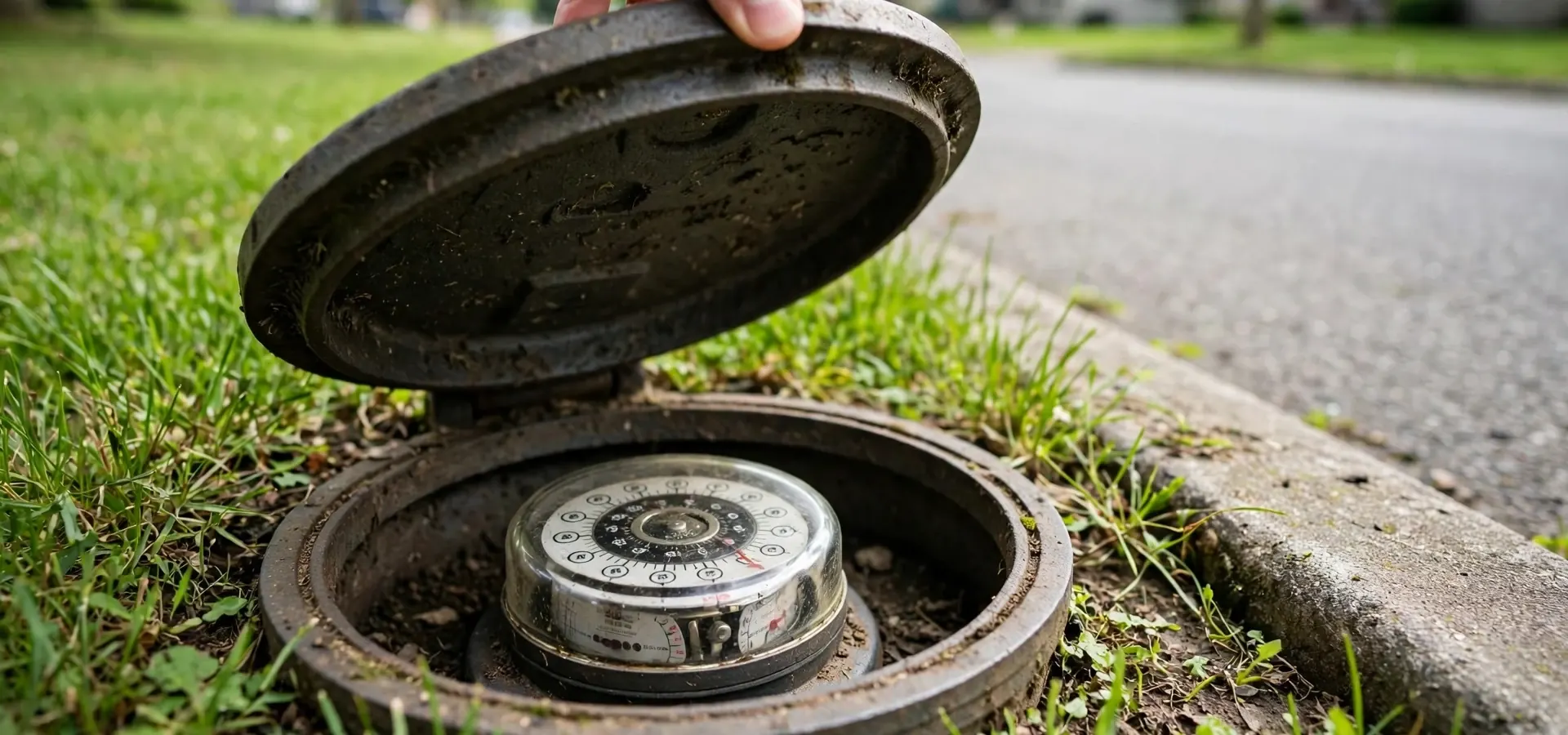
The quick answer: a moving meter means water is leaving
When every tap, appliance, and hose is off and the meter still moves, water is escaping somewhere between the meter and the fixtures. Most of the time it is a toilet, followed by a dripping faucet, a leaking water line, or an irrigation fault. The cause is findable, and the sooner you start, the less you pay for water that goes nowhere.
The US Environmental Protection Agency says the average household leaks more than 9,300 gallons of water per year, and about nine percent of homes leak 50 gallons or more per day. A bill that jumped without a change in habits is a good reason to test.
Run the meter test
This is the EPA method. It takes two hours and no tools.
- 1
Shut everything off
Close every tap, and make sure the dishwasher, washer, ice maker, and humidifier are not running. Stop any irrigation timer.
- 2
Read the meter
Lift the meter box lid. Write down the full reading, and note whether the small low-flow dial or triangle is spinning.
- 3
Wait two hours
Use no water at all. Do not flush a toilet, and tell everyone in the house.
- 4
Read it again
Any change in the reading means a leak is likely. If the dial still spins at the start, you do not even need to wait.
Where the water usually hides
Check these in order, because the top ones are the cheapest to fix.
A silent toilet leak
A worn flapper lets water seep into the bowl with no sound. Add food coloring to the tank. If color reaches the bowl in 10 minutes without flushing, the flapper is leaking.
Dripping faucets and showerheads
A faucet dripping once per second wastes more than 3,000 gallons a year, according to the EPA.
A water heater relief valve
A small dribble at the discharge pipe can run all day. Check the pipe end for moisture.
The line from meter to house
A leak underground shows as a soggy patch, a green strip of lawn, or low pressure.
Irrigation and outdoor taps
A valve stuck open or a cracked sprinkler head can run water for days.
What the meter tells you
Read the pattern, not just the number.
| What you see | What it suggests | Where to look next |
|---|---|---|
| Low-flow dial spins slowly | Small constant leak | Toilet flappers, faucets |
| Meter jumps every few minutes | Intermittent leak, often a toilet | Dye test every toilet |
| Steady fast spin | Large leak or open line | Shut off main, check outdoors |
| No change in two hours | Leak ruled out | Review use, appliances, season |
| Changes only when irrigation is on | Irrigation leak | Test zones one by one |
| Moves, even with main shut at the house | Leak between meter and house | Underground line check |
Isolate the leak with the main valve
Once you see movement, close the main shutoff valve where the line enters the house and watch the meter. If it stops, the leak is inside the house. If it keeps moving, the leak is on the buried line between the meter and your foundation.
That second finding changes the job. Our water line repair crew handles the buried run, and a detection visit finds the spot first so the dig stays small.
One caution about the meter itself
The meter and its box belong to the water utility. Read and look, but do not turn, tap, or open the valve on the utility side. If the box lid is stuck, flooded, or the dial is cracked, call the utility.
When the meter is moving and nothing visible is wrong
Hidden leaks sit in walls, under slabs, and behind tile. Clues include a warm spot on the floor, a musty smell, peeling paint, or water pressure that fell for no reason. Hot water lines in a slab often show as a warm floor patch.
A plumber confirms the spot with acoustic listening, thermal imaging, or a pressure test, and then opens as little as possible. A planned leak detection visit costs less than guessing with a hammer.
Before you call: five minutes that save time
These notes let a plumber work faster.
- Write down the meter reading and the time, before and after the test.
- Note whether the low-flow dial moved with the main shut.
- Photograph the wet spots, bills, and the meter dial.
- List any changes: new appliance, irrigation start-up, recent freeze.
- Move furniture and boxes away from suspect walls and the water heater.
- Keep the main shutoff unblocked so anyone can reach it.
Mistakes that keep the bill high
The first is waiting for next month's bill to confirm the problem. Another is assuming a high bill must be the utility's error, without testing. A third is shutting the main off and forgetting to open it again.
People also ignore the water heater. A relief valve leak or a slow drip into a floor drain is easy to miss. Check it before you pay for deeper searching.
Talking to the water utility about the bill
Call the water utility, give them the meter reading and the date of your test, and ask whether the meter has been checked recently. Bring bill dates so the pattern is clear. Ask what their policy is for leak-related bills, since rules differ and a plumber cannot speak for the utility.
Keep the plumber's invoice and notes on the repair. If you need to explain the high usage, those papers show you found and fixed the cause.
Covington, KY: what to know before you start
Northern Kentucky Water District serves 99 percent of Kenton County households, so a high bill in Covington, Fort Wright, or Taylor Mill most often goes through the same utility. Ask the district where its responsibility ends and yours begins on the service line.
For work on the water service from the meter to the house, the Kentucky Division of Plumbing says a permit is needed, and permit rules vary, so ask the Division of Plumbing or the local plumbing inspector first. Covington also has many older homes, and a long-buried line is a likely suspect when the meter moves with the main shut at the house.
Source type: KCPC (NKWD share), DHBC (water service permit), EPA (leak figures)
Frequently asked questions
Water is leaving through a leak, most often a toilet flapper, dripping faucet, or leaking line. Use the two-hour test, then close the main valve to learn whether the leak is inside or on the buried line.
Add food coloring to the tank and wait 10 minutes without flushing. Color in the bowl means the flapper leaks. Check every toilet in the house.
It is possible, but rare compared with leaks. Run the test first, and if the reading holds steady with water off, ask the utility to check the meter.
It can be, but fixtures and the buried line are more common. A warm floor patch, sound of running water, or a moving meter with the house main shut are clues. A plumber confirms before opening anything.
The price depends on access, method, and the size of the property. You get a clear price before work starts. Call our 24/7 line to describe the meter behavior.
Tell your landlord or property manager in writing with the test results. They arrange a licensed plumber, and your notes speed up the diagnosis.
Northern Kentucky Water District serves 99 percent of Kenton County households, so start with the district for meter and billing questions. Call a plumber for anything on your side of the line, and ask the district exactly where its side ends.