
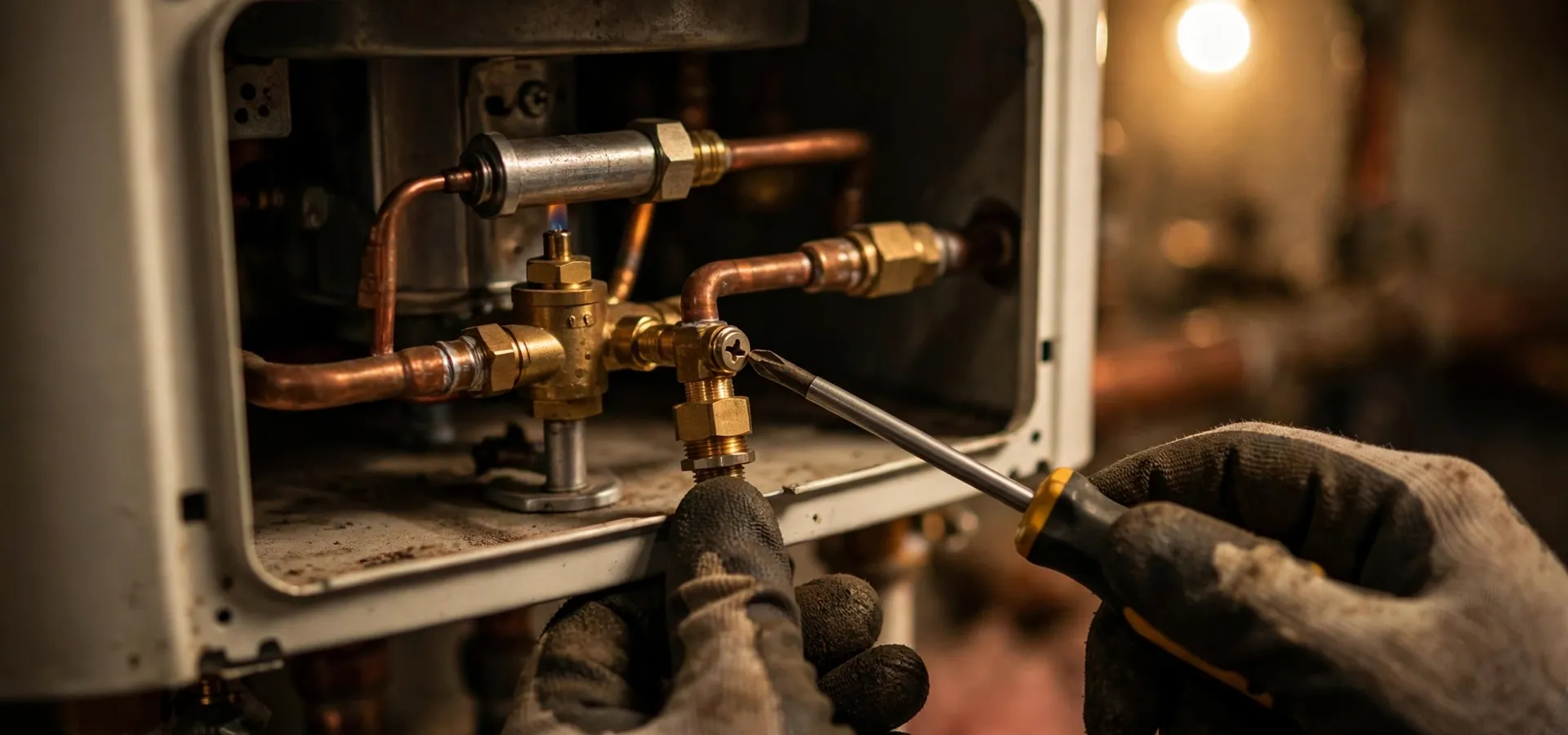
Gas safety comes before everything else
If you smell gas, leave the building right now. Do not flip switches, use a phone inside or look for the source. Once outside, call your gas utility or 911. Only come back to this guide after the utility says the house is safe.
What the thermocouple does and why it fails
A thermocouple is a short metal probe that sits in the pilot flame. The heat makes it produce a tiny electric current, and that current holds the gas valve open. If the flame goes out, the current stops and the valve closes, so gas cannot leak into the room.
The probe wears out. Soot coats the tip, the metal weakens after years of heat, and the connection at the gas valve loosens or corrodes. The usual result is a pilot that lights while you hold the button, then goes out when you let go.
Is it the thermocouple or something else?
A pilot that dies can have more than one cause. Rule these out before buying a part.
Pilot lights but dies on release
This is the textbook thermocouple symptom. The part is not making enough current to hold the valve open.
Pilot will not light at all
Check for a blocked pilot tube, a dead igniter or a gas supply that is turned off before blaming the probe.
Yellow, floppy pilot flame
The flame should be blue and steady. A weak yellow flame can be dirt or poor air, and it heats the probe poorly.
Pilot goes out after hours
Drafts, venting trouble or a flame that is slightly off the probe can cause a delayed shutdown.
Burner fires but no hot water
That points to the thermostat, gas control valve or a sediment-clogged tank, not the thermocouple.
Before you touch anything
Do these checks first. They prevent mistakes with a gas appliance.
- Confirm there is no gas smell in the room, the basement or near the meter.
- Turn the gas control knob to OFF and wait at least five minutes so any gas can clear.
- Close the gas shutoff valve on the supply line to the heater.
- Let the unit cool for about 30 minutes to avoid burns on the burner and tube.
- Take a photo of the tubing and wiring so you can match them when you put it back.
- Buy the right part: universal thermocouples vary in length, so match the length and the end fitting.
The swap, step by step
These are the usual steps on a standard atmospheric gas tank heater. Your manual overrides this list.
- 1
Remove the burner access cover
Slide the lower door off. Find the pilot assembly, where a thin copper tube runs from the gas control valve to the flame.
- 2
Unscrew the old thermocouple
Loosen the nut at the gas valve with a wrench, then pull the probe tip out of the pilot bracket. Keep the nut and bracket for the new one.
- 3
Install the new probe
Slide the tip into the bracket so it sits in the flame zone. Thread the nut in by hand, then snug it a quarter turn with a wrench. Over-tightening can crush the fitting.
- 4
Relight and test
Open the gas valve, set the control to PILOT, hold the button, light the pilot and keep holding for 30 to 60 seconds. Release slowly. If the pilot stays lit, turn to ON and check the main burner.
Should you fix it, call a plumber or replace the heater?
Match your situation to a next step.
| Situation | Best move | Why |
|---|---|---|
| No gas smell, pilot dies, heater under 8 years | Replace the thermocouple | Cheap part and short job |
| Pilot dies again within days | Call a plumber | Valve, draft or venting may be at fault |
| Heater 10 to 15 years old | Weigh replacement | Storage tanks last 10 to 15 years per the DOE |
| Rust on the tank or water pooling | Plan replacement | Corroded tanks fail suddenly |
| Any gas smell | Leave and call gas utility or 911 | Gas leaks are never a DIY matter |
| Soot, scorch marks, backdraft | Stop and call a plumber | Combustion or venting problem |
Mistakes that turn a small repair into a risk
Skipping the five-minute wait
Gas that has pooled near the floor can ignite on relight. Wait, ventilate and sniff first.
Bypassing the safety valve
Some videos show taping or jumping the valve to keep it open. Never do that. The thermocouple exists to stop gas when the flame is out.
Overtightening the nut
A crushed fitting leaks. Snug plus a quarter turn is the usual rule.
Using a part that is too short or too long
The tip must sit in the flame. A part that is the wrong length will not heat evenly.
Ignoring a repeat failure
A second thermocouple that fails fast points to a deeper problem, and it is a good time for a professional check.
When the heater's age changes the answer
The US Department of Energy says storage tank water heaters last 10 to 15 years. If yours is near that, a new thermocouple may only buy you a short extension, because the tank itself is the part that fails. A small repair on a 13-year-old tank is usually a gamble.
Check the serial number sticker for the build date. If the tank is old, rusted at the bottom or has been leaking at the fittings, talk with a plumber about water heater replacement before you spend an afternoon on a part.
What a professional adds
A plumber tests the thermocouple's output with a meter instead of guessing, checks the gas control valve, inspects the venting and confirms the flame pattern. Those checks matter because a bad valve or a blocked flue can make a new thermocouple fail.
If the heater needs more than a part, our team can handle full gas water heater repair and explain the price before work starts.
Covington, KY: what to know before you start
Covington's housing is old. The city's population peaked at 65,252 in 1930, and many homes from that era have basements with tight utility corners, old flue pipes and appliances that were replaced several times. In a cramped basement, a gas heater and its vent need extra attention, because poor venting is more common than a bad thermocouple.
If you smell gas, leave the building and call your gas utility or 911 before anything else. For replacement work, Kentucky's plumbing rules apply, and permit rules vary, so ask the Kentucky Division of Plumbing or the local plumbing inspector when a heater is moved or newly installed.
Source type: W (Census-derived population), DOE (water heater lifespan), DHBC (permits and Kentucky Division of Plumbing)
Frequently asked questions
If the pilot lights while you hold the button and goes out when you release it, the thermocouple is the prime suspect. A plumber can confirm with a millivolt test.
Many handy homeowners do, as long as there is no gas smell and the heater is standard. Turn the gas off, follow the manual and relight carefully. If you feel unsure, call a licensed plumber.
There is no fixed number. Heat and soot wear the part down over years, and the tip may fail sooner if the flame is dirty or misaimed.
The thermocouple is doing its job by shutting off gas. The danger is bypassing it or relighting without checking for gas. If you smell gas, leave and call your gas utility or 911.
The DOE says storage tanks typically last 10 to 15 years. If yours is near the end, ask about replacement alongside repair, and we explain the price before work starts.
Our 24/7 emergency line takes after-hours calls for no hot water and heater leaks, and same-day appointments are available when the schedule allows. Gas smells go to your gas utility or 911 first.
Kentucky's State Plumbing Code applies under KRS 318.130, and permit rules vary, so ask the Division of Plumbing or the local inspector. Neighbors in Ludlow and Taylor Mill follow the same state code.