
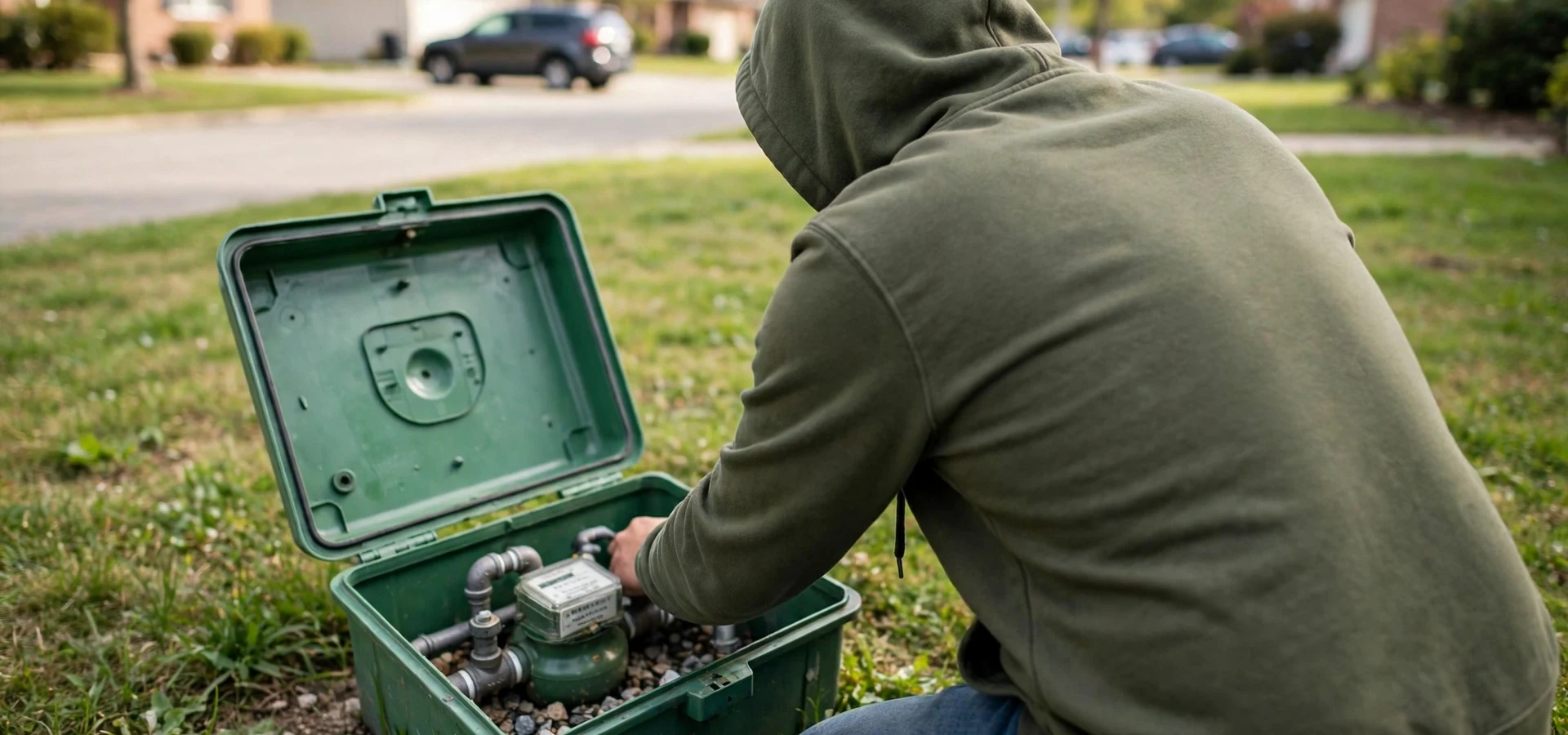
Start with the meter, not the shovel
The cheapest way to find out whether you have an underground leak is a two-hour meter test. The EPA gives the method. Turn off every faucet, appliance and ice maker, read the water meter, wait two hours with no water use, and read it again. Any change means a leak is likely.
If the dial moved, you have a leak. If the meter did not move, the water you are seeing in the yard may come from rain, a drain or a sprinkler zone, not a pressurized supply line. That one test saves most homeowners from digging in the wrong place.
Pin down which pipe is leaking
After a positive meter test, narrow the search in four moves.
- 1
Shut the house valve and recheck
Close the main valve at the house and watch the meter. If it still moves, the leak is between the meter and the house, which means it is in the buried service line. If it stops, the leak is inside the home.
- 2
Check the meter's low-flow dial
Most meters have a small triangle or wheel that spins with very slow flow. If it turns with everything off, even a pinhole leak is visible.
- 3
Walk the line with your eyes
Look for soft, green or sunken ground, a patch that never dries and moss on a path. Follow the route from meter to house.
- 4
Listen at the valve
Press a screwdriver handle to the shutoff and your ear to the handle. A steady hiss with taps closed points to water escaping nearby.
Signs the leak is underground
Look for these patterns before calling.
Wet spot with no rain
A damp patch that stays soggy during dry weeks suggests a pressurized line, not runoff.
Lawn that greens and sinks
Extra water feeds grass faster than the rest of the yard. A bright green stripe or a slight dip often follows the pipe.
Pressure drops at the faucets
A big leak pulls water away before it reaches the house, so showers weaken or taps sputter.
Higher bill, same habits
Compare two months of water use. An unexplained jump that lines up with no change in your household is the classic clue.
Hissing near the meter or main
A faint rush of water when the house is quiet is a sound a trained ear can follow.
How pros locate a buried leak
Different methods suit different pipes and soils. This table shows what each one does and where it falls short.
| Method | What it finds | Limit |
|---|---|---|
| Acoustic listening | The sound of water escaping a pressurized pipe | Road noise and plastic pipe can muffle it |
| Pressure testing | Whether a section holds pressure when isolated | Shows a leak exists, not exactly where |
| Thermal imaging | Warm or cool patches from hot line leaks | Weak for deep, cold lines |
| Tracer gas | Gas rising through soil from a filled pipe | Needs a pipe that can be emptied and filled |
| Line locator | The route of the pipe so crews dig in the right place | Does not find the leak by itself |
| Camera | Drain and sewer pipe condition | Not for pressurized supply lines |
What you can do versus what needs a plumber
You can run the meter test, check the low-flow dial, look over the yard and shut off the main. You can also take photos and note where the ground is soft. All of that is useful on the phone and costs nothing.
Digging is where homeowners get into trouble. A buried line may sit under a driveway, a root system or another utility, and a trench started in the wrong spot is a repair on its own. Before you break ground in Kentucky, call 811 to have underground utilities marked, then let a plumber confirm where the leak sits with equipment.
If water is surfacing in the yard
A geyser or a flooding patch is urgent. Here is what to do in order.
Close the house main
Shut the valve where the line enters the building. If the leak is on the street side of the meter, ask your water utility how to shut off at the meter.
Keep people and pets away
Saturated ground can collapse, and water near a foundation may undermine a step or patio. Mark the wet area with cones or chairs.
Protect the house
Move stored items off basement floors and watch for water coming through the foundation wall or floor drain.
Call a plumber and photograph
Take pictures of the wet area and the meter dial reading. Then call our 24/7 line so the leak can be located and fixed.
Mistakes to avoid
Digging on a hunch
A wet spot is where water surfaced, not always where the pipe broke. Water travels along gravel and pipe for several feet.
Ignoring a small leak
A small leak keeps running, and the EPA says household leaks waste more than 9,300 gallons a year on average. It also washes soil from around the pipe.
Assuming the sprinkler caused it
Irrigation leaks are common, but test the meter with the sprinkler off before you blame it.
Skipping the call to 811
Gas, electric and fiber lines can run close to water lines. Cutting one is dangerous and expensive.
A figure to keep in mind
The EPA reports that nine percent of homes have leaks wasting 50 gallons or more per day. At that rate, a slow underground leak can lose thousands of gallons before it shows on the surface.
Repair options once the leak is found
A short section of failed pipe is often spot-repaired with a new piece and couplings. If the whole run is old galvanized or has leaked in several places, replacing the line is the smarter fix, and plumbers may dig a trench or pull a new pipe through the old route. Your plumber can explain which suits your yard, and you can read more about water service line repair for the options.
Ask about restoring the surface too. Lawn, gravel, walkways and driveways are often handled separately from the plumbing.
Covington, KY: what to know before you start
Northern Kentucky Water District supplies 99 percent of Kenton County households, so your meter sits inside the utility's system. Ask NKWD where its responsibility ends and yours begins, since the repair path depends on the side. The Kentucky Division of Plumbing says water service from the meter to the house needs a plumbing permit, but permit rules vary, so ask the Division of Plumbing or the local plumbing inspector before digging.
Underground trouble can be a drain, not a water line. Sanitation District No. 1 manages sewers in Covington, and an older combined system carries sewage and stormwater together. If you see a sinkhole, blockage or backup, the failing pipe may be your private sewer lateral, which you own up to the connection with SD1. Call SD1 at 859-578-7450 to ask how to report it.
Source type: KCPC (NKWD service share), DHBC (permit for water service), SD1 (combined sewer, private lateral), EPA (meter test, leak figures)
Frequently asked questions
Turn off all water use, read the meter, wait two hours and read it again. The EPA says any change means a leak is likely. Also watch the low-flow dial for slow movement.
A meter that moves with everything off, plus a wet or unusually green patch in the yard. Together they point to a pressurized line below the surface.
Often, yes. Acoustic and thermal tools can point to a likely spot before any concrete is cut. Our leak detection team handles this, and homeowners in Fort Wright can call the same line.
Typically the property owner, though you should ask NKWD where its ownership ends, and water line repair covers that stretch. The leak is usually on your side if the meter keeps moving after you shut the main valve.
If water is surfacing or the ground is washing out, treat it as one and call our 24/7 line. A slow leak can wait for a same-day appointment when available.
Usually the owner is responsible for the supply line, including in Park Hills rentals. Tenants should report wet ground and a rising bill in writing and keep the meter reading.
A water line leak makes the meter move and the ground wet. A sewer lateral problem shows up as blockages, backups, overflow or a sinkhole, and the lateral is the owner's to maintain. If you are unsure, call SD1 and a plumber.